The historical part of the story
Language
within reach.
A word and the world connected through touch. This is a story about access to language, not a story about a cure.
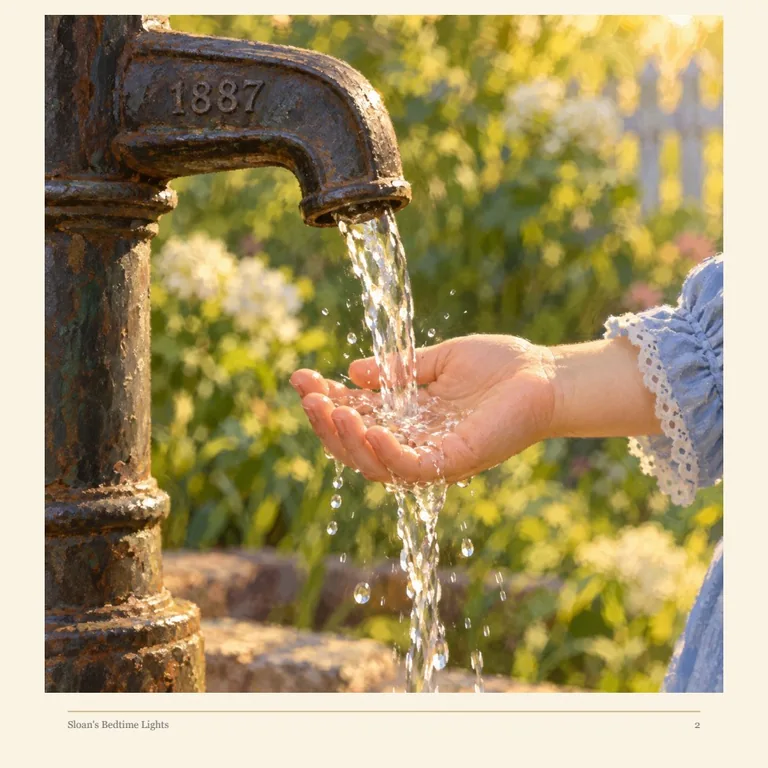
1887 · The water pump
Water in one hand.
A word in the other.
Anne Sullivan placed Helen Keller’s hand beneath flowing water and fingerspelled the word water into her other hand. Helen connected the spelling with the thing she was feeling.
The American Foundation for the Blind dates this moment to April 5, 1887. Sullivan had arrived to teach Keller the month before.
Historical summary from the AFB biography cited on physical PDF page 37; the book introduces the moment on pages 4–15.
The change was access.
The movements of fingers represented letters. The letters formed a word that named the flowing water. Touch brought language into reach in a way that watching a board or listening to spoken instruction did not.
“Anne brought language into reach through touch.”Book narrator · Physical PDF page 13
This does not mean Helen had no thoughts before the pump. The book describes learning as giving her more ways to share the person she already was.
A life beyond that moment.
Keller went on to read and write, and became an author and an advocate. The AFB biography describes a substantial literary career and work to expand opportunities for others. Her life is not only one childhood scene.
Helen remained deafblind. Language access did not cure her disabilities. Her story should not ask a child to prove their worth by overcoming a disability or accomplishing something exceptional.
Book physical pages 17 and 19; AFB’s “Education and Literary Career” and “Political and Social Activism” sections.
Then the book turns toward today.
From physical page 20, the book introduces a present-day reflection about wanting to be understood. The girl, Mom and brindle Cali belong to that reflection. They were not present at the historical water-pump moment.
Here, a child may use words, pictures, writing, movement, signs or their own familiar communication tools. There is no need to copy Helen’s experience, rehearse hand shapes, or pretend to be deafblind.
Try the original companion message board →Read the sources, in context
The historical illustrations are interpretations, not photographs or exact reconstructions. The modern reflection is original book writing, not quotations from Keller or Sullivan. This companion is not endorsed by AFB.
AFB: Helen Keller’s biography (opens in a new tab)Read the complete illustrated book (opens in a new tab)